
The Three Questions Most Store Owners Skip When Hiring The Best E-commerce Automation Agency
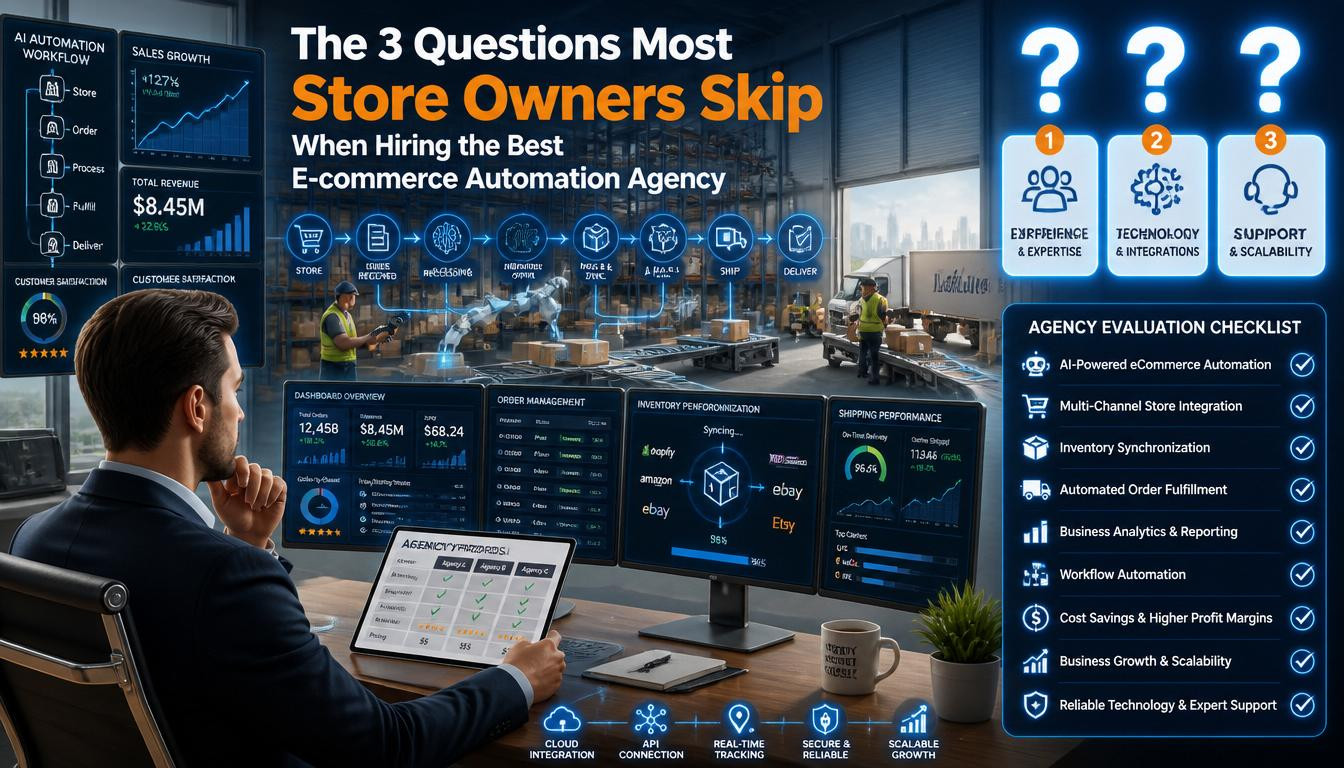
A store with 800 monthly orders loses 11 hours each week just fixing stock mismatches. That is before shipping or returns. Most owners start their search for the best ecommerce automation agency by comparing price lists and reading testimonials. That is backward.
I have watched twenty-seven stores make this mistake. They sign a contract. Six months later, they still export CSVs to Excel. The agency blames the platform. The owner blames the agency. Nobody looked at the real problem first.
You need three questions. Answer these before you book a single demo.
Question One: Where Do Your Manual Tasks Multiply?
Pick two repetitive tasks that annoy your team daily. Not ten tasks. Two.
Examples. Matching PayPal settlements to order IDs. Copying tracking numbers into customer emails. Generate return labels one by one. Updating inventory after a wholesale order ships.
Track how many minutes each task takes. Do this for ten days. A home goods brand I worked with did this exercise. They discovered 9 hours weekly spent just on return label creation. That is a full workday. Every week.
Now ask yourself. Would the e-commerce automation agency fix those two tasks first? Or would they sell you a bundle of fifty features you never use?
The right agency asks you for your two tasks. Then they build rules for those only. Once those run without errors for thirty days, you add a third task.
Question Two: What Breaks Under Your Peak Load?
Batch processing works fine on a Tuesday. Tuesday has 50 orders. Black Friday has 200 orders per hour. That is when things break.
Here is what happens. Your store sends order data to the warehouse. The warehouse API accepts 30 requests per second. You send 60 per second. Half fail. Some fail silently. You discover this three days later when customers email asking where their order is.
A good agency will ask for your peak order per minute number, and not your average. Then they test their scripts at double that load.
Ask them for a simulation by giving them your order data from your busiest day last year. Watch them run it live. If they hesitate, move on.
I know a shoe store that skipped this test. They signed with an agency. Their peak load came. Orders dropped into a black hole. The agency said, "Upgrade your Shopify plan." That was not the fix. The fix was a proper queue system. But by then, the damage was done.
Question Three: How Much Does One Data Mismatch Cost You?
Do not use percentages. Use dollars.
One mismatched inventory item sells out online but is gone in the warehouse. Here is the real cost.
Refund to the customer costs 30 dollars. The transaction fee for the refund costs 1 dollar. The discount code you give to apologize costs 10 dollars. Staff time to write the apology email costs 5 dollars. The total cost is 46 dollars per incident.
Now count your mismatches last month. Twenty mismatches equal $920 lost. That is money gone. No product shipped. No customer retained.
Now multiply by twelve months. $11,040.
A competent e-commerce automation should guarantee a mismatch reduction target. Put a number on it. 90% reduction within 60 days. Write that into the contract. If the agency refuses, they do not trust their own work.
THE AGENCY AUDIT TABLE – WHAT TO ASK BEFORE A DEMO
| Agency Question | Good Answer | Bad Answer | Why This Matters |
| How do you handle API rate limit errors? | We build a queue with automatic retries and dead letter logging. | Our system just retries. | Silent failures kill order accuracy. |
| Can you sync inventory across three channels in under 5 seconds? | Yes, with webhooks. Show us your peak load test. | Yes, but it depends on the channel. | Real time is not real time if it takes 2 minutes. |
| What is your process for returns automation? | We trigger labels at the return request and auto-refund upon scan. | We can set up a return portal. | Return portals without backend automation just add steps. |
| Do you write custom scripts or use visual builders? | Custom scripts for complex rules, visual for simple tags. | We only use visual builders. | Visual builders hit limits at scale. |
Use this table as your filter. An agency that gives three "bad answers" should not get your business.
One Real Example: How A Home Goods Store Fixed Its 3PL Lag
A home decor brand with 1500 monthly orders had a recurring problem. Their warehouse API timed out during sales events. Orders would show as paid on the store but never reach the warehouse. Customers waited weeks. Refund requests piled up.
They hired a small automation agency. Not a big name. A four-person team. The agency built a simple queue system. An intermediate storage layer that holds each order until the warehouse confirms receipt. If the API times out, the order stays in the queue. It retries every thirty seconds. No data lost.
Over the next three sales events, the store processed 4200 orders. Zero dropped. Zero customer emails about missing confirmations.
The Agency Cost
The agency costs 3500 dollars per month. The store saved an estimated 900 dollars per month in refund-related losses. Staff stopped spending 6 hours weekly manually checking which orders failed. That time went back to customer service.
Red Flags That Disqualify An Agency Immediately
THREE SIGNS. WALK AWAY IF YOU SEE ANY
First, they cannot name a specific API limit for your platform. Shopify has different rate limits than BigCommerce. Alternatively, WooCommerce depends on your hosting. If the agency says "don't worry about limits," they have never handled real scale.
Second, the ones who suggest you "just upgrade your plan" as the fix for all performance issues. Upgrading helps. But it does not fix bad code. An agency that blames your platform will keep blaming it.
Third, they have no documented error recovery procedure. Ask for a one-page PDF. What happens when their script fails at 2 AM? Who gets alerted? How long until someone fixes it? If they cannot produce a simple document, they are not serious.
One Action To Take Today
Write down your top two manual task pain points. Write down your peak hourly order volume from the last six months. Bring those numbers to your first agency call.
An agency that asks good questions back is the one you want. They will ask you about your error logs. They will ask about your return rate. They will ask about your least favorite part of the day.
The best ecommerce automation agency is not the loudest marketer. It is the one that first understands your broken workflows. Then fixes them. One task at a time.
Five Quick FAQs
What is the typical cost of hiring the best ecommerce automation agency?
Between 2000 dollars and 8000 dollars per month for custom workflows. Plus a one-time setup fee of 5000 dollars to 15000 dollars.
How long does it take to see ROI from an automation agency?
Most stores see positive ROI within 3 to 5 months. Calculate the monthly cost divided by labor hours saved times your staff's hourly rate.
Can a small store under 500 orders per month benefit from automation?
Usually no. Use Zapier or native app automations first. Hire an agency only when those fail, or you pass 1000 orders per month.
Do I need to share my customer data with the agency?
Yes for setup. But the agency must sign a data processing agreement. Your data stays in your own cloud environment.
What happens if the agency goes out of business?
You own the scripts. Put this in the contract. Request a code repository transfer clause. Keep a copy on your own drive.